Aardman Animations represents one of animation’s most distinctive voices, a British studio that transformed humble claymation into Oscar-winning feature films that compete with Disney and Pixar.
“Chicken Run” (2000), airing April 2nd on Viasat Kino, was Aardman’s first feature film, proving that stop-motion animation could deliver blockbuster entertainment while maintaining the handcrafted charm and British wit that made “Wallace & Gromit” beloved worldwide.
What Is Stop-Motion? The Painstaking Art
Stop-motion animation is the oldest animation technique, predating hand-drawn and computer animation. Animators physically manipulate objects, such as clay figures, puppets, and models, moving them incrementally between individually photographed frames. When played at 24 frames per second, these still images create the illusion of movement.
The Process: Frame by Frame
Creating one second of stop-motion requires 24 individual photographs. For a 90-minute film like “Chicken Run,” that means approximately 129,600 frames. Each frame requires meticulous positioning, lighting, and photography. Animators might spend an entire day creating 3-5 seconds of finished animation.
This laborious process means stop-motion is exponentially more time-consuming than CGI animation. “Chicken Run” took nearly five years to complete, with dozens of animators working simultaneously on different scenes across multiple sets.
Why Stop-Motion? Texture and Charm
In an era when computer animation was becoming dominant (“Toy Story” was released in 1995), Aardman deliberately chose the slower, harder stop-motion technique. Why?
Stop-motion has unique qualities: Tactile texture that CGI struggles to replicate, Handcrafted imperfections that add charm and character, Physical weight and presence that feels real, Distinctive visual style that’s instantly recognisable, Connection to animation’s history and artisanal tradition.
Nick Park, Aardman’s co-founder and creative director, has said that fingerprints visible on clay characters are features, not flaws; they’re evidence of human touch in an increasingly digital world.
Aardman’s History: From Wallace & Gromit to Features
Aardman Animations was founded in 1972 by Peter Lord and David Sproxton in Bristol, England. For decades, they produced commercials, music videos, and short films using stop-motion claymation.
Wallace & Gromit: British Icons
Nick Park joined Aardman in 1985 and created “Wallace & Gromit”, a cheese-loving inventor and his long-suffering dog. The shorts “A Grand Day Out” (1989), “The Wrong Trousers” (1993), and “A Close Shave” (1995) won multiple Academy Awards and made Aardman internationally famous.
Wallace & Gromit’s success demonstrated that stop-motion could appeal to sophisticated adult audiences while entertaining children, a balance that would define Aardman’s feature films.
The DreamWorks Partnership
In the late 1990s, Aardman partnered with DreamWorks Animation to produce feature films. DreamWorks provided financing and distribution; Aardman retained creative control. This partnership enabled “Chicken Run” to have a $45 million budget, massive for stop-motion but modest by CGI animation standards.
“Chicken Run” (2000): The Great Escape with Chickens
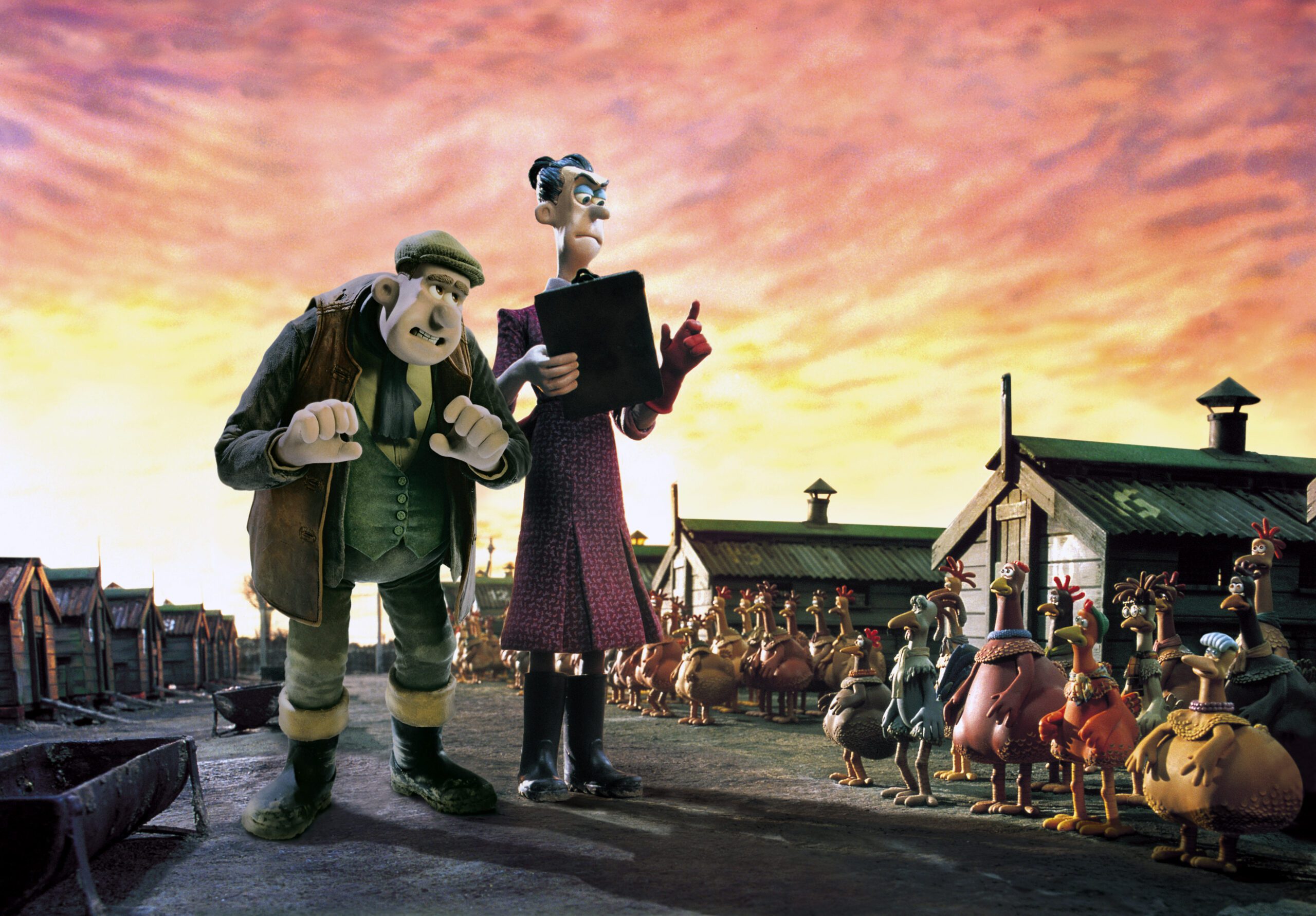
“Chicken Run” tells the story of Ginger, a plucky hen who leads her fellow chickens in escape attempts from Tweedy’s Farm, a battery farm where chickens who don’t produce eggs become chicken pies. When Rocky, the American rooster, crash-lands on the farm, Ginger sees an opportunity for a mass escape.
The Concept: “The Great Escape” Meets Poultry
Directors Peter Lord and Nick Park consciously modelled “Chicken Run” on classic World War II prisoner-of-war films, especially “The Great Escape” (1963). The parallels are deliberate: Tweedy’s Farm = POW camp, Mrs Tweedy = brutal commandant, Escape attempts and tunnel digging, Roll call and solitary confinement (“the coal bin”), Planning the “big one” – mass escape.
This adult framework gave children’s animation unexpected depth and allowed Aardman to include darker themes (impending death, authoritarianism, sacrifice) within a family-friendly story.
British Humour: Wit and Understatement
“Chicken Run” is quintessentially British in its humour: Dry wit and understatement, Class commentary (British chickens vs. American rooster), Slapstick tempered with verbal cleverness, Dark comedy about mortality and being turned into pies, Stoic determination in the face of adversity.
American audiences sometimes miss the specifically British cultural references, but the physical comedy and universal themes (freedom, community, courage) transcend cultural boundaries.
The Voice Cast: British Excellence
Mel Gibson (as Rocky) was the big American star name to attract international audiences, but the British cast provided authentic voices: Julia Sawalha (Ginger) – determined, brave, natural leader, Miranda Richardson (Mrs. Tweedy) – terrifying, greedy villain, Tony Haygarth (Mr. Tweedy) – henpecked, bumbling husband, Timothy Spall (Nick) – black market rat, Jane Horrocks (Babs) – dim but sweet knitting enthusiast.
The voice acting was recorded before animation began, allowing animators to sync lip movements and expressions to actual performances rather than generic mouth shapes.
The Animation Process: Five Years of Work
“Chicken Run” employed over 200 people at its peak, working across 30 sets simultaneously. The production required: 400 chicken models to accommodate wear and tear, Multiple sets for simultaneous filming, Lighting rigs that couldn’t move between frames, Armatures (metal skeletons) inside clay to maintain poses, Replacement mouths and eyes for different expressions.
Technical Innovations
Aardman developed new techniques for “Chicken Run”: Digital compositing to combine stop-motion with CG effects (the pie machine), Rig removal in post-production (erasing support structures), Weather simulation (rain on miniature sets), and camera tricks for forced perspective and depth.
These innovations allowed stop-motion to compete visually with CGI animation while maintaining its handcrafted aesthetic.
Challenges: Scale and Consistency
Stop-motion at feature length presented unprecedented challenges: Character consistency across hundreds of puppets, maintaining continuity across years of filming, preventing clay from melting under hot lights, coordinating dozens of animators to match style, and storage and organisation of thousands of props and sets.
Aardman’s meticulous planning and experienced staff (many had worked on “Wallace & Gromit”) enabled them to overcome these obstacles, delivering a film that looked seamless despite years of production.
Critical and Commercial Success: Breaking Through
“Chicken Run” premiered in June 2000 to critical acclaim and strong box office. It grossed over $224 million worldwide massive for stop-motion, and became the highest-grossing stop-motion film until “Wallace & Gromit: The Curse of the Were-Rabbit” (2005).
Reviews: Universal Praise
Critics loved “Chicken Run”: Roger Ebert gave it 3.5/4 stars, praising its wit and craftsmanship. The Guardian called it “genuinely thrilling” and “surprisingly dark.” Entertainment Weekly highlighted the meticulous animation and clever script, Rotten Tomatoes: 97% Fresh – nearly universal critical approval.
Reviewers consistently noted that stop-motion’s tactile quality created an emotional connection that CGI struggled to match. Audiences could feel the effort and artistry in every frame.
Awards: Recognition but No Oscar
Curiously, “Chicken Run” was not nominated for Best Animated Feature at the Academy Awards because that category didn’t exist until 2002. Had it been released two years later, it likely would have been a strong contender.
However, it won numerous other awards: BAFTA for Best British Film, Annie Awards for animation excellence, and Satellite Awards for Best Animated Film.
Aardman’s Legacy: Continuing the Tradition
“Chicken Run’s” success enabled Aardman to produce more feature films: “Wallace & Gromit: The Curse of the Were-Rabbit” (2005) – Won Best Animated Feature Oscar, “Flushed Away” (2006) – Aardman’s only CGI film (they disliked the process), “Arthur Christmas” (2011) – CGI, co-produced with Sony, “The Pirates! Band of Misfits” (2012) – Return to stop-motion, “Early Man” (2018) – Stop-motion prehistoric comedy, “Shaun the Sheep movies” – Spin-off from Wallace & Gromit universe.
Why Stop-Motion Survives
In an era of photorealistic CGI, stop-motion remains relevant because: Distinctive aesthetic that stands out from CGI homogeneity, Artisanal appeal to audiences tired of digital perfection, Directors like Wes Anderson and Tim Burton championing the medium, Passionate fanbase that values handcrafted animation, Netflix and streaming providing new platforms for stop-motion content.
Aardman proved that stop-motion wasn’t a dying art but a vibrant, evolving medium capable of competing with billion-dollar CGI studios.
Cultural Impact: British Animation Powerhouse
“Chicken Run” established Aardman as Britain’s premier animation studio, rivalling Disney and Pixar for quality if not output volume. The studio became a source of national pride, proof that British creativity and craftsmanship could compete globally.
Influence on Animation
Aardman’s success influenced: Laika Studios (Coraline, Kubo) – American stop-motion features, Wes Anderson – Fantastic Mr Fox, Isle of Dogs – Anderson cited Aardman as a major inspiration, Independent animators worldwide – Proving stop-motion was viable, Film schools – Renewed interest in traditional animation techniques.
Watch Aardman’s Masterpiece on Viasat Kino
This April, experience the film that proved stop-motion animation could deliver blockbuster entertainment while maintaining handcrafted charm and British wit.
Viewing Schedule
Chicken Run (2000) – Adventure/Animation/Comedy
- Thursday, April 2, 2026, at 06:10 (6:10 AM EET)
- Directors: Peter Lord, Nick Park | Cast: Mel Gibson, Julia Sawalha, Miranda Richardson, Phil Daniels
- Aardman’s first feature film – The Great Escape with chickens in Oscar-winning claymation
FAQ: Aardman and Stop-Motion
How long did Chicken Run take to make?
“Chicken Run” took nearly five years from initial development to release (1996-2000). The actual animation took 18 months, with over 30 sets running simultaneously and hundreds of staff. Stop-motion is extremely time-consuming; animators might complete only 3-5 seconds of finished animation per day.
Why didn’t Chicken Run win an Oscar?
The Best Animated Feature category wasn’t created until 2002, two years after “Chicken Run” was released. Before 2002, animated films could only compete for Best Picture (extremely rare) or technical awards. Had the category existed, “Chicken Run” would likely have been nominated and possibly won.
Is stop-motion harder than CGI animation?
Yes, significantly harder and slower. CGI animators can create scenes, duplicate characters, and adjust movements digitally. Stop-motion requires physically moving every character for every frame 24 times per second. However, stop-motion creates a unique tactile quality that CGI struggles to replicate, making the extra effort worthwhile for aesthetic reasons.
What happened to the Aardman-DreamWorks partnership?
The partnership ended in 2007 after three films (“Chicken Run,” “Wallace & Gromit: Curse of the Were-Rabbit,” “Flushed Away”). Creative differences and DreamWorks’ pressure to use CGI led Aardman to seek other partners. Aardman now works with Sony Pictures and StudioCanal while maintaining creative independence.
Why does Aardman prefer stop-motion over CGI?
Aardman’s founders believe stop-motion’s handcrafted aesthetic is essential to their identity. Nick Park has said visible fingerprints on clay are beautiful evidence of human touch. After trying CGI for “Flushed Away,” they returned to stop-motion because digital animation felt soulless compared to physical puppets. It’s an artistic choice, not a technical limitation.
Are there really fingerprints visible on the characters?
Yes! If you look closely at Aardman films, you can sometimes see tiny fingerprints, tool marks, and slight imperfections in the clay. Aardman considers these features, not flaws; they’re proof the animation was handmade by real people, not generated by computers. This imperfection is part of stop-motion’s charm.
Will there be a Chicken Run sequel?
Yes! “Chicken Run: Dawn of the Nugget” was released on Netflix in December 2023, 23 years after the original. The sequel continues Ginger and Rocky’s story with their daughter, Molly. It received positive reviews and proved the audience’s appetite for more Aardman stop-motion features.
How many chicken puppets were used in Chicken Run?
Over 400 chicken puppets were created for “Chicken Run.” Clay characters deteriorate with constant handling, so multiple versions of each character were needed for different scenes and to replace damaged puppets. Main characters like Ginger had dozens of puppet duplicates to ensure consistency throughout the 18-month filming period.